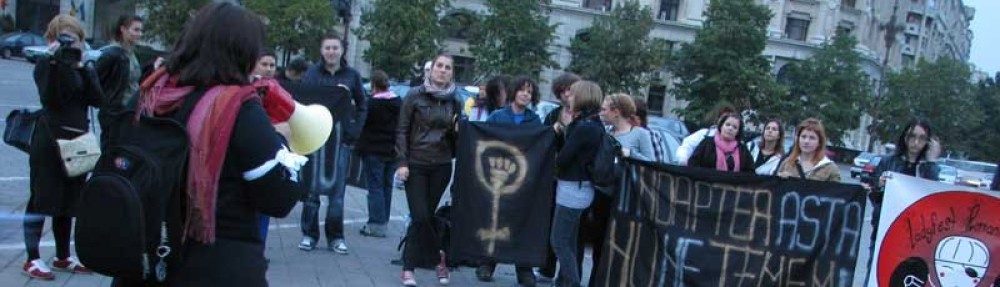
ladyfest romania / fia @ hack.fem.east
10 May 2008 by andreea — feedbackwhoever’s interested one room of the hack.fem.east exhibit in berlin is dedicated to romanian social media initiatives, one of which is ladyfest romania / fia , the others being indymedia romania and d media.
Apel la actiune pentru munca decenta, viata decenta
2 May 2008 by Administrator — feedbackDecent Work Decent Life Call to Action
fwd Doina
În ciuda creşterii economice mondiale, populaţia globului nu îşi vede viaţa ameliorată ca rezultat.
Pe lângă şomajul semnificativ, mulţi sunt într-o situaţie de angajare precară sau neplătiţi pentru munca efectuată. Jumătate din forţa de muncă a planetei câştigă mai puţin de 2 $ pe zi. 12, 3 milioane de oameni muncesc in sclavie. 200 de milioane de copii sub 15 ani muncesc în loc să meargă la şcoală. 2,2 milioane de oameni mor datorită accidentelor de muncă şi bolilor profesionale în fiecare an. Oamenii din ţările în curs de dezvoltare şi din ţările dezvoltate muncesc mai mult pentru un salariu mai mic, şi din ce în ce mai mulţi oameni - în marea lor majoritate femei – sunt forţaţi să-şi câştige traiul în aşa-numita economie informală, pe piaţa neagră, în slujbe nesigure şi fără protecţie socială sau drepturi. În acest timp, companiile se folosesc de ameninţarea cu delocalizarea unităţilor de producţie pentru a diminua salariile şi drepturile câştigate cu greu cum ar fi dreptul la contractul colectiv de muncă şi la grevă. Sindicaliştii care se luptă împotriva acestor tendinţe sunt daţi afară, ameninţaţi, încarceraţi sau chiar omorâţi.
Doar un sistem internaţional bazat pe solidaritate şi respect pentru drepturile oamenilor, înscrise în convenţiile Naţiunilor Unite şi a Organizaţiei Internaţionale a Muncii pot opri această tendinţă. Cerem guvernelor să semneze aceste convenţii, să le implementeze urgent şi să facă din munca decentă centrul preocupărilor lor politice.
În iulie 2006, reprezentanţii guvernelor la Comitetul Economic şi Social al Naţiunilor Unite au adoptat o Declaraţie ministerială care exprimă în primul articol următoarele:
„Suntem convinşi de nevoia urgentă de a crea la nivel naţional şi internaţional un climat care să conducă la angajare deplină şi productivă şi muncă decentă pentru toţi ca bază a dezvoltării sustenabile.”
Apelul lor trebuie însoţit de ratificarea şi implementarea standardelor Organizaţiei Internaţionale a Muncii, într-un moment în care agenţiile internaţionale folosesc noul pachet de măsuri al Naţiunilor Unite pentru a canaliza munca decentă şi angajarea ca prim pas pentru o mai mare coerenţă a politicilor şi convergenţă în îndeplinirea angajamentului de muncă decentă pentru toţi.
Timpul de a îndeplini această promisiune este ACUM.
Considerăm că munca decentă este esenţială pentru eradicarea sărăciei, pentru îmbunătăţirea traiului oamenilor şi pentru a le asigura o viaţă în pace şi demnitate. De aceea cerem celor responsabili să:
Read the rest of this entry »
ziua barbatului care se dispretuieste, se pare
25 April 2008 by ruxi — feedbackde citit: “leapsa: ziua femeii, ziua barbatului” de jo @ the essential bystander [link transmis de cristina]
din arhive:
- un post de anul trecut in care propuneam ca daca tot ne intereseaza sa cream zile-de-militare-pentru-dreptul-barbatului-de-a-nu-lasa-capacul-de-la-wc-si-alte-trasaturi-masculine-definitorii de ce nu facem si o “zi a barbatului de origine europeana” sau “o zi a dictaturii comuniste” si tot felul de alte “zile” hilare prin care sa sarbatorim backlash-ul impotriva miscarilor anti-opresiune?! e ce zice si jo si e bineinteles un punct foarte simplu. (dar ma indoiesc ca cei vizati de leapsa vor pricepe ceva.)
- si inca un post in care eu chiar celebrez o “zi a barbatului” si ma solidarizez cu barbati care au nevoie de sustinere pentru ca pricep si rezista presiunilor patriarhale (si reclamelor la bere s.a.m.d.).
despre solutii care agraveaza problema - si solutii reale
24 April 2008 by ruxi — feedbackintr-un caz recent de violenta domestica din canada, o tanara agresata de partenerul ei a fost retinuta de politie in momentul in care a refuzat sa depuna marturie impotriva agresorului. despre caz - si felul in care in numele “protectiei” victimelor sistemul abuzeaza, in loc sa ajute, persoanele cele mai vulnerabile - la: “stop abuse with abuse” @ woc phd.
este doar un exemplu de esec al legilor contra violentei domestice si implementarii lor, atata timp cat se acorda prea putina atentie factorilor multipli ce intervin in vietile femeilor ne-majoritare. mai multe informatii (si resurse) in acest post mai vechi despre istoria si criticile aduse miscarii contra violentei de gen (en).
o alta ilustratie a aceleiasi probleme e data de alexandra oprea (in textul ei despre necesitatea integrarii experientelor femeilor rome in orice activism “feminist”, ca si in orice activism antirasist):
In Romania exista numeroase bariere in orice proces ce implica violenta domestica; spre exemplu: victimei ii revine sarcina de a inainta o plangere preliminara inainte ca agresorul sa fie arestat, un certificat medical eliberat in conditiile legii este necesar pentru a inregistra o plangere, nu exista reprezentare legala gratuita, de multe ori politia impiedica aducerea in instanta a cazurilor si este o mare criza de adaposturi in toata tara. In 2002, in Romania erau in total sapte adaposturi pentru victime ale violentei domestice.
Aceste bariere afecteaza femeile rome in mod disproportionat din cauza pozitiei lor la intersectia intre rasism, saracie si sexism. Cerinta de a obtine un certificat medico-legal inseamna o mare greutate pentru femeile rome carora deseori le sunt refuzate tratamentele medicale in spitale din cauza rasismului. Problema inregistrarii unei plangeri fara a avea acces la reprezentare legala gratuita inseamna o alta bariera pentru femei rome sarace, multe dintre care, pe langa faptul ca nu au o stabilitate financiara, nu detin nici capitalul social necesar pentru a naviga sistemul legal. Pe langa faptul ca sunt atat de putine adaposturi in Romania in general, numarul de adaposturi care sa fie accesibile femeilor rome este probabil zero, din cauza atitudinilor rasiste prevalente in societatea romaneasca. In plus, apelarea la politie inseamna o bariera cat se poate de serioasa, data fiind brutalitatea epidemica a politiei impotriva comunitatilor rome. Cand femeile rome suna la politie, de multe ori politia refuza sa vina in zone populate de romi – mai ales in ghetto-uri…… O abordare de jos in sus a acestei probleme ne-ar obliga sa luam in considerare femeile rome sarace, care de multe ori se tem sa dea telefon la politie din cauza brutalitatii acesteia fata de comunitati rome, carora de multe ori le este refuzat tratamentul medical la spitale si care nu au acces la tribunal si la sistemul legal, sau slujbe care sa le permita sa paraseasca situatii abuzive. Folosirea acestor experiente ca fundatie pentru cercetarea pe violenta domestica din Romania ar avea ca rezultat un discurs mai aproape de realitate.
din pacate, chiar informatiile-stas oferite ca ajutor de organizatii altfel pozitive ca artemis (si chiar si aceasta brosura in care noi am preluat acele informatii) se fac vinovate de trecerea cu vederea a diverselor circumstante in care se pot afla persoanele agresate. subiectul este de maxima importanta si actualitate: pe langa faptul ca aplicarea legii 217/2003 privind combaterea violentei domestice lasa in continuare foarte mult de dorit, anul acesta asteptam imbunatatiri si sa fie introdus ordinul de restrictie [ca fapt divers, Moldova tocmai a promulgat si ea o lege anti-violenta] si in acelasi timp “deputatii cer masuri europene pentru stoparea discriminarii romilor”. insa asa cum arata alexandra, numai o abordare de jos in sus si luand in considerare factori ca genul, etnia, statutul economic etc. impreuna ne poate fi de vreun folos daca vrem sa rezolvam ceva si sa existe ajutoare reale pentru toti cei care se gasesc in situatii vulnerabile!
(un articol recent, de asemenea util aici: “Rom European - Discriminare la medic?”)
Oppose attempts to ban abortion in Lithuania
21 April 2008 by Administrator — feedbackAn appeal to solidarity from January 2008:
Dear European feminists,
On behalf of the parliamentary group on Population and Development, Reproductive Health and Rights of the Lithuanian Republic and on behalf of all educated and progressively thinking women and men of Lithuania I address you and ask for a moral support and solidarity in stopping the attempt of the conservative parliamentarians and social organizations to ban abortion in our country. The project of the law to safeguard an unborn life, to force women give birth even to an abnormal child, to criminalize abortion is backed up by the Lithuanian Catholic Church, which negates women reproductive rights.
read the open letter (francais)
Now, there is increased need for action. More at the f-word and feministing.
fwd: on men explaining things to women
18 April 2008 by andreea — feedbackA text about the “generousity” of men explaining things to women by Rebecca Solnit
http://www.commondreams.org/archive/2008/04/13/8257/
Oaxaca, Mexico: 2 Indigenous Women Journalists Murdered
11 April 2008 by andreea — feedbackApril 7th, 2008. Oaxaca, Mexico.
PLEASE REPOST!
Two indigenous triqui women who worked at the community radio station La Voz que Rompe el Silencio (The Voice that Breaks the Silence), in the autonomous municipality of San Juan Copala (Mixteca region), were shot and murdered while on their way to Oaxaca city to participate in the State Forum for the Defense of the Rights of the Peoples of Oaxaca. Three other people were injured.
Read the rest of this entry »
Reimaginarea justitiei sociale de jos in sus: Includerea femeilor rome
8 April 2008 by ruxi — feedbackO traducere integrala a lucrarii “Re-invisioning Social Justice from the Ground Up: Including the Experiences of Romani Women” de Alexandra Oprea (link la fisier PDF)
International Roma Day
8 April 2008 by Administrator — feedback8 aprilie a fost adoptata ca Zi Internationala a Romilor in 1971, in cadrul Primului Congres international al romilor de pretutindeni, care a avut loc la Londra. Tot atunci s-au stabilit imnul (Gelem, Gelem, compus de Jarko Jovanovic) si steagul international al romilor. Romii din tarile blocului comunist nu au celebrat aceasta zi, pana spre finele anilor 90’. In ultimii ani, semnificatia zilei de 8 aprilie a inceput sa fie recunoscuta la nivel mondial. Pe 28 martie 2006, Plenul Camerei Deputatilor a adoptat, cu majoritate de voturi, proiectul de lege privind declararea zilei de 8 aprilie drept “Sarbatoarea etniei romilor din Romania”. (info de la Romani Criss)
—
Vienna, 7 April 2008
“European Union needs common action to make equality a reality for the Roma”
Statement by the European Union Agency for Fundamental Rights (FRA) on the occasion of International Roma Day
Read the rest of this entry »
the “new” romania - message from the h.arta girls
7 April 2008 by elena — feedbackDear friends!
We have just returned from Bucharest, where between 2-4 of april took place the biggest NATO summit in history.Some people, (between 50 and 100) wanted to express their opinions about this summit, about war and militarization and a space was rented in Bucharest as a place for discussion, workshops, projections (and, in the “worst”case and only in the opinion of some of the participants, as a starting point for peaceful, quiet march in the city,in the conditions in which any public manifestation, no matter as peacefull, was oficially forbidden during the summit ). On the 2nd of april, the first day of summit, the riot police entered this space, beaten up people and arrested everybody inside without any legal basis, just on the presumption that “something might happen”. Later on that day they had to release everybody, as a consequence of the interventions of human rights groups and of people piqueting the police stations. But even if the detained people were released, the surveillance and the threats from the part of police continued.
It would be quit a lot to say about what happened there, about the atmosphere of terror, about the mass-media campaign that started weeks before the summit to construct an image of the “dangerous anarchists” that will destroy the city and our image of nice, obeying country, about people denied entry at the border on the reason that they had on them flyers against NATO and against violence, about the harassment of the people involved and also of their families and friends, about the surveillance of phones and internet activity made official and legal, etc. If you are interested you can read about these on indymedia romania site (http://romania.indymedia.org/) and also in other independent media.
We wanted to tell you also about what is happening to us. In September 2007, we were part of a project called Spatiul Public Bucuresti | Public Art Bucharest 2007 (http://www.projectspacebucharest.blogspot.com/, www.spatiul-public.ro), project in the frame of which we conceived and organized the events of a Project Space. Some of the people with whom we worked at Project Space were also involved in organizing a program of cultural events in reaction to the NATO summit in Bucharest. During the anti NATO protests in Bucharest and now, after we have return to Timisoara we realized that we were under the observation of the secret police even since September when we were working at the Project Space. Our phones are listened to, we are followed on the street (and our followers don’t even hide) and we have just discovered some strange connections in our laptops which allow remote access to all the data inside to some persons that we don’t know (we used our laptops during Project Space events and many people had access to them).
Although it is definitely distressful to know that you are constantly watched, it is not the case that they could find the evidence of any illegal activity whatsoever from our part. The only thing that we did, and that we will continue doing, is to express our citizen right to the freedom of speech. And only because of this, our private lives are wide opened to the eyes of some people payed from our tax money to harass us. The only reaction we can think off is to make this harassment as visible as possible, to tell everyone about it. This is the reason of this email.
One of the main critiques of Romanian communism is in relation to the constant surveillance, to the fact that you could not trust anybody and that all your moves and all your words were constantly observed. Now, when in our country any idea of the Left is so righteously condemned as “totalitarian” and “communist” with the purpose to reinforce even more capitalism as the only possible alternative, the constant surveillance is still part of the everyday life. It is enough to state publicly your opinions and you will be subjected to the same sort of surveillance as before 1989, even if now we are living the “freedom” times of capitalism.
Best wishes from us!
Maria, Rodica, Anca
presa romaneasca si uber misoginii reprezentativi
18 March 2008 by Administrator — 1 feedbackpentru cine isi mai aduce aminte de “minunata” postare a tipului cu subiectiv.ro despre “noi” (sau, mai degraba, despre niste probleme de-ale lui) - am observat recent ca omul, care e clar de o misoginie psihopata, scrie pe hotnews.ro… SUPER!
deci asta e ce ne putem astepta de la mass media… a se observa ca pe langa alex mihaileanu, varzaru de la catavencu e chiar feminist iar jurnalistul de la romania libera e seful feminismului! asa ca sa zicem mersi ca ei au scris de lf07 - putea fi mai rau.
re: prostitution - read both
18 March 2008 by Administrator — feedback“How to get an activist movement to keep women in prostitution” @ the f word
“Decriminalization, ending demand, and choice: Feministe interviews the Sex Workers Project” @ feministe
no se
16 March 2008 by ruxi — feedbackno lo soporto, “no se”
grip like a vice
16 March 2008 by ruxi — feedbackthe go! team, “grip like a vice”
threads and knives
16 March 2008 by ruxi — feedbacktelepathe, “threads and knives”
girl move away from here
16 March 2008 by ruxi — feedbackjolly goods, “girl move away from here”
from worldwatch on global population
16 March 2008 by ruxi — feedbackThe average woman worldwide is giving birth to fewer children than ever. Nonetheless, an estimated 136 million babies were born in 2007, bringing the global population to about 6.7 billion. Governments must improve access to good health care and family planning to see further declines in childbearing and increases in life expectancy…
More: Population, Nature, and What Women Want
For the Worldwatch Institute, human population has always been a sustainability issue. Our earliest writings confirmed a stable balance between population and the environment as an essential ingredient of the equitable and enduring society our mission advances. And over the years we have highlighted the polices needed in all nations to encourage this balance through healthy reproduction, voluntary family planning, gender equality, and the free decisions of women and couples about childbearing.
Since our founding, however, the issues surrounding population have become ever more sensitive and delicate, discouraging many environmentalists and policymakers from taking on the topic. Now, Worldwatch Vice President for Programs Robert Engelman, a 16-year veteran of the population and reproductive health field, has broken new ground in his own fresh take on this perennially difficult issue. In More: Population, Nature, and What Women Want, Engelman leads readers on a journey from humanity’s first steps on two feet to the 21st century and beyond to explore whether women want more children or more for their children, and how their childbearing intentions have fared in a male-dominated world. The answers he finds not only surprise but offer new hope for real and lasting global sustainability.
Rich in historical detail, contemporary stories, and provocative ideas, More is the keystone of a new initiative at the Worldwatch Institute to return population and women’s reproductive decision-making to their critical role in the environment, the economy, and human rights.
Vital Signs Update: Fertility Falls, Population Rises, Future Uncertain.
women in the city - plenty
16 March 2008 by ruxi — feedback
Barbara Kruger, “Plenty”
“Women in the City” is a viral public art exhibition spread throughout the streets of Los Angeles that will start in February 2008.
The work of four seminal women artists, who began to emerge on the international art scene at the beginning of the ’80s within the feminist movement, will penetrate the urban and social geography of the city.
Jenny Holzer, Barbara Kruger, Louise Lawler and Cindy Sherman disseminate their work in various locations in on-the-road billboards, video screens, storefronts, a movie theater and even propagation through widely distributed stickers.
Why “Women in the City”? One of the fundamental achievements of the historical feminist movement was the appropriation of the streets: thousands of women were invading the cities of the western world fighting for their rights. Now that those rights have been asserted and women have begun to fully permeate and influence politics, culture and the art system, “Women in the City” can showcase the art of women in empowered position.
Call for Rebel Girl, Rebel Worlds: An Anthology of International Grrrl Zines
13 March 2008 by Administrator — feedbackRebel Girl, Rebel Worlds: An Anthology of International Grrrl Zines
By Elke Zobl (Austria) with Red Chidgey (UK), Sonja Eismann (Germany/Austria) and Hayde Jimenez (Mexico/USA)
DO YOU PUBLISH A ZINE WITH A FEMINIST TAKE AND WOULD LIKE TO CONTRIBUTE TO AN INTERNATIONAL ANTHOLOGY OF GRRRL ZINES?
We are zine activists who believe that the cut’n'paste revolution is an important part of contemporary movements for social change; whether it’s talking about messed up beauty standards, how to change rape culture, or how to fix the wheels on your bike, zines are crucial documents for everyday change, empowerment, and education.
To create a living archive of feminist zines from across the globe, we are working on an overview of the international Grrrl Zine Network; bringing together primary documents on a wide range of topics with analyses of the strengths and challenges of the Third Wave feminist movement. Based on Elke’s web site GRRRL ZINE NETWORK - A resource site for international grrrl, lady, queer and trans folk zines, distros and DIY projects (http://grrrlzines.net
Read the rest of this entry »
english
romana